
Angelman Syndrome: Connecting Science to Real-Life Perspectives
Understanding the Genetic Basis, RNA-Targeted Research Approaches, and Lived Experiences
Angelman Syndrome: Defining the Rare Neurodevelopmental Disorder
Angelman syndrome (AS) is a rare neurodevelopmental disorder caused by changes affecting the UBE3A gene on chromosome 15, which plays an important role in brain development.1,2
An estimated 1 in 21,000 people worldwide are living with Angelman syndrome.3
Advances in genetics continue to expand our understanding of Angelman syndrome and the biological mechanisms that contribute to the condition, creating new opportunities for research and innovation.1,2
The Genetics of AS: Unlocking the UBE3A Pathway
At the center of Angelman syndrome is the UBE3A gene, which provides instructions for making a protein that supports normal brain function.1,2,4
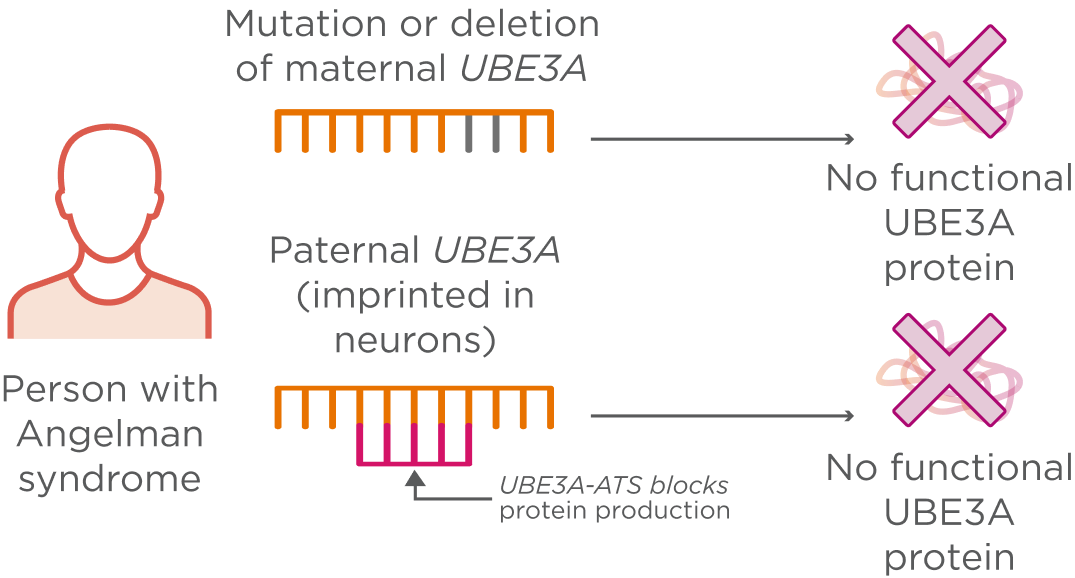
Most genes are expressed from both maternal and paternal copies. However, in neurons, UBE3A is unique because of a naturally occurring process called genomic imprinting. While both copies of the gene are inherited, only the maternal copy is typically active in brain cells. The paternal copy is naturally silenced by a regulatory RNA transcript known as UBE3A-ATS.1,2,4
In individuals with Angelman syndrome, the maternal copy is missing, mutated, or abnormally silenced. Without this functional UBE3A protein, the brain cannot develop or function in the typical way.1,4
Genetic Causes of Angelman Syndrome
Angelman syndrome can result from several genetic mechanisms, including1,4:
- Chromosomal deletions involving the maternal UBE3A region on chromosome 15, which account for most cases (~70%)
- Pathogenic variants in the UBE3A gene
- Imprinting defects that affect normal gene expression
- Paternal uniparental disomy (UPD), in which both chromosome copies are inherited from the father
Although these genetic causes differ, they all ultimately reduce functional UBE3A activity in the brain.
Connecting Through Experience: The In Rare Life (IRL) Video Series
Understanding the biology of Angelman syndrome is only part of the story. Behind every diagnosis is an individual, a family, and a community navigating the realities of daily life.
From Biology to Breakthrough: The Evolution of RNA-Targeted Therapeutics
Growing knowledge of genetics and RNA biology has helped researchers better understand the mechanisms involved in conditions such as Angelman syndrome. Understanding the genetic basis of Angelman syndrome has opened new avenues for therapeutic research, particularly approaches that target RNA to influence gene expression.2,5
The Mechanism: How RNA-Targeted Therapy Works
Messenger RNA (mRNA) serves as the body's blueprint for making proteins.6 RNA-targeted therapeutics are designed to interact with specific RNA sequences to influence protein production, potentially increasing or decreasing the production of a particular protein.5 In neurological diseases caused by genetic mutations or imprinting defects, like Angelman syndrome, RNA-targeted therapies offer the potential to target the underlying molecular mechanism rather than only managing symptoms.2,7
Interested in learning more about RNA-targeted therapeutics?
Explore how these approaches work and the science behind them.

Antisense Oligonucleotides: Investigating the Potential to Restore UBE3A
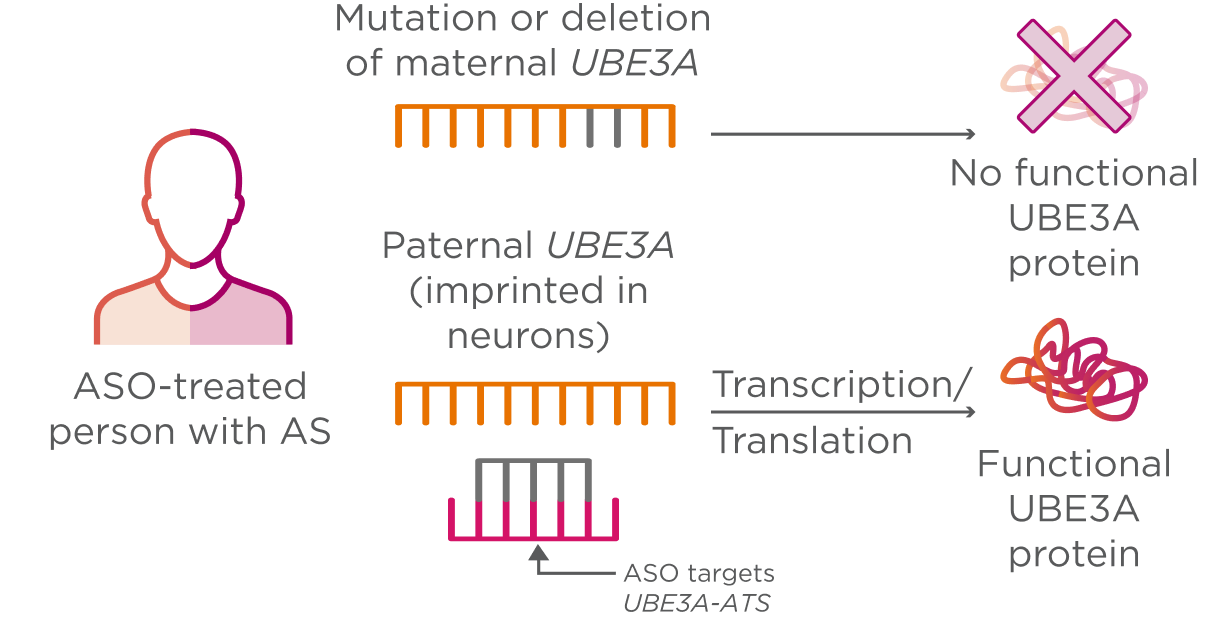
Antisense oligonucleotides (ASOs) are short strands of synthetic nucleic acids designed to target RNA.5 In Angelman syndrome, researchers are investigating whether ASOs can be designed to target UBE3A-ATS, the RNA transcript responsible for silencing the paternal copy of UBE3A in neurons.2,7
The goal of this approach is to reduce the activity of UBE3A-ATS and enable expression of the paternal UBE3A gene and subsequent UBE3A protein production, targeting the pathophysiology underlying Angelman syndrome.2,7
Angelman Syndrome Frequently Asked Questions
Common characteristics of Angelman syndrome may include2,8,9:
- Developmental delays that typically become noticeable between 6 and 12 months of age
- Severe speech impairment or minimal verbal speech
- Difficulty with movement, balance, and coordination (ataxia)
- Low muscle tone
- Seizures, often beginning in early childhood
- Sleep disturbances
- Behavioral issues
- Frequent smiling, laughter, and a generally happy, excitable demeanor
While these characteristics are common, Angelman syndrome affects each person differently, and symptoms and severity can vary from individual to individual
Currently, there is no cure for Angelman syndrome and no approved disease-modifying therapies.2 Treatment focuses on managing symptoms and supporting development through a multidisciplinary approach that may include physical therapy, speech and communication interventions, seizure management, behavioral support, and sleep management.1
Researchers are actively investigating potential therapies, including approaches designed to restore UBE3A gene function. Several investigational therapies are currently being evaluated in clinical trials.2,7
Angelman syndrome is generally considered a non-degenerative condition, and many individuals live well into adulthood with a near-normal life expectancy. As people with Angelman syndrome age, their symptoms and care needs may change. Although some features, such as seizures, may improve or become more manageable over time, challenges related to behavior, anxiety, communication, and independence often persist and may evolve. Expressive communication remains markedly limited for many individuals, and most require lifelong support and supervision throughout adulthood.2
Genomic imprinting is a naturally occurring process in which only one parent’s copy of a gene is active while the other is silenced. In neurons, the UBE3A gene is normally expressed from the maternal copy, while the paternal copy is turned off. Because of this, loss of the maternal UBE3A gene can result in Angelman syndrome.2
Our Commitment to Neurology
For more than 30 years, Ionis has been a leader in RNA-targeted innovation, bringing multiple medicines to patients with serious diseases. Today, we are applying that expertise to advance research across a broad range of neurological conditions.10
From rare genetic disorders such as Angelman syndrome and Alexander disease to prevalent neurodegenerative diseases including Alzheimer's and Parkinson's disease, our research is focused on understanding the underlying biology of disease and exploring potential new treatment approaches for patients with significant unmet needs.7
Learn more about our research across rare and prevalent neurological diseases.
Discover ongoing research and clinical studies in neurology.
Connect with organizations and educational materials.
References
- What is Angelman syndrome? Angelman Syndrome Foundation. Accessed August 6, 2026. https://angelman.org/about-angelman-syndrome/
- Madaan M, Warner D, Corado A. Angelman syndrome. In: StatPearls. Treasure Island (FL): StatPearls Publishing; June 4, 2026.
- Ionis Pharmaceuticals. Ionis completes enrollment in pivotal cohort of the Phase 3 REVEAL study evaluating obudanersen in Angelman syndrome. Accessed September 22, 2026. https://ir.ionis.com/news-releases/news-release-details/ionis-completes-enrollment-pivotal-cohort-phase-3-reveal-study
- Angelman syndrome. MedlinePlus. Accessed August 6, 2026. https://medlineplus.gov/genetics/condition/angelman-syndrome/
- Bajan S, Hutvagner G. RNA-based therapeutics: from antisense oligonucleotides to miRNAs. Cells. 2020;9(1):137.
- Messenger RNA (mRNA). National Human Genome Research Institute. Accessed August 6, 2026. https://www.genome.gov/genetics-glossary/Messenger-RNA-mRNA
- Ionis Pharmaceuticals. Pipeline. Accessed August 6, 2026. https://www.ionis.com/science-and-innovation/pipeline
- Angelman syndrome. MedlinePlus. Accessed August 6, 2026. https://medlineplus.gov/ency/article/007616.htm
- Sadhwani A, Willen JM, LaVallee N, et al. Maladaptive behaviors in individuals with Angelman syndrome. Am J Med Genet A. 2019;179(6):983-992.
- Ionis Pharmaceuticals. The Ionis story. Accessed August 6, 2026. https://ionis.com/about-us/the-ionis-story


